
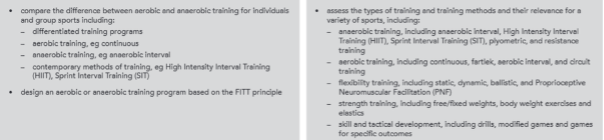
When introducing aerobic and anaerobic training, consider using contrasting sport footage—such as triathlon versus futsal—as a stimulus. Ask students to identify which energy systems are in use and how this shapes training demands. This moves the learning beyond theory into applied analysis and introduces students to the kind of evaluative thinking they’ll need in Year 12.
When students use the FITT principle to design a training session, prompt them to justify their choices: Why continuous over fartlek? What adaptations are expected? How might this differ for a midfielder compared to a goalkeeper?
Similarly, when teaching anaerobic training, integrate data sources like GPS tracking or athlete testing results from specific sports. Ask students to explain which training methods would be most effective for 400m sprinter (HITT of plyometric, for example), justifying their reasoning with sport specific benefits and outcomes.
These kinds of practical applications don’t require major changes to your programming – but they do promote transferable thinking and set students up for success in Year 12.
Collaborative Investigation: Build the Skillset, Not the Stress
The collaborative investigation offers a powerful opportunity to develop student agency and foster authentic collaboration in what can often be competitive learning environments. Here are some key reminders:
- Skills ≠ Content: The research skills listed under specific content points can be taught independently of that content. There’s no requirement to pair them rigidly.
- No HSC Assessment for research skills: Unlike other subjects, the research methods and skills developed in the CI are not assessed in the HSC. This allows you to focus on the process – supporting the development of collaborative learning cultures where students build confidence in their interdependence to achieve successful outcomes
- Guided Choice Matters: While the CI is designed to encourage student direction, they still need guidance – especially in crafting an appropriate and manageable research question. Too much freedom without scaffolding can lead to indecision and lost learning time.
Use this opportunity to cultivate a collaborative culture of learning – one that not only supports skill development but also sparks genuine engagement and excitement in students about what they’re learning.
Need some help with the Collaborative investigation?
ACHPER NSW have developed full unit plans, assessment task notification and rubric, team portfolios and collaboration resources for both Focus Area 1 and Focus Area 2 to support the delivery of the CI in Term 3. You can purchase them now using the links below:
 Focus Area 1: How can we improve the health of young people in our community?
In this unit of work students will research the determinants impacting the health of young people and investigate strategies that promote healthy outcomes. The culminating presentation will involve groups presenting a comprehensive suite of strategies to improve the health outcomes for young people in their local community.
CLICK TO PURCHASE NOW

Focus Area 2: How can we improve performance through skill acquisition and training methods?
In this unit students investigate the characteristics of learners, the acquisition of skill, practice methods, performance elements and feedback. They will explore the difference between aerobic and anaerobic training methods and programs. Groups will design a training program for a selected sport or athlete that will improve their performance through skill acquisition and enhanced fitness.
CLICK TO PURCHASE NOW
Depth Studies: Strategic Deep Dives
If you still have one depth study left in your program, consider making a deliberate choice about its focus:
- Which content areas flow directly into Year 12?
- Could a deep dive now reduce the instructional load later?
- Might this be a chance to build conceptual fluency before shifting to application in Year 12? For example, a depth study on the purposes of fitness testing could explicitly examine recreational and elite athletes as two distinct population groups. Students could then select a third group of their choice and draw comparisons across all three, highlighting how fitness testing supports health, performance, and participation outcomes in different contexts.
Other strategic options include:
- Exploring the Sustainable Development Goals (specially SDG 3, 4, 10 & 11) in relation to a local health issue.
- Investigating determinants of health and social justice principles as they affect a particular population (young people and Aboriginal and Torres Straight Islander people).
- Comparing the physiological adaptations that result from applying training principles in both aerobic and anaerobic contexts, across individual and team sport athletes.
These studies can serve as conceptual bridges between the two stages of the course, consolidating knowledge and providing early exposure to key analytical frameworks essential for year 12.
Formative Assessment: Track Understanding, Not Just Progress
Formative assessment remains a key tool for understanding student learning in real time. In the HMS context, this could include quick check-ins like exit tickets after a lesson on training adaptations, annotated diagrams comparing energy systems, peer feedback on draft collaborative investigation questions, or short written responses justifying the selection of a training method for a specific athlete. These low-effort strategies can provide rich insight into student understanding and help inform your next steps.
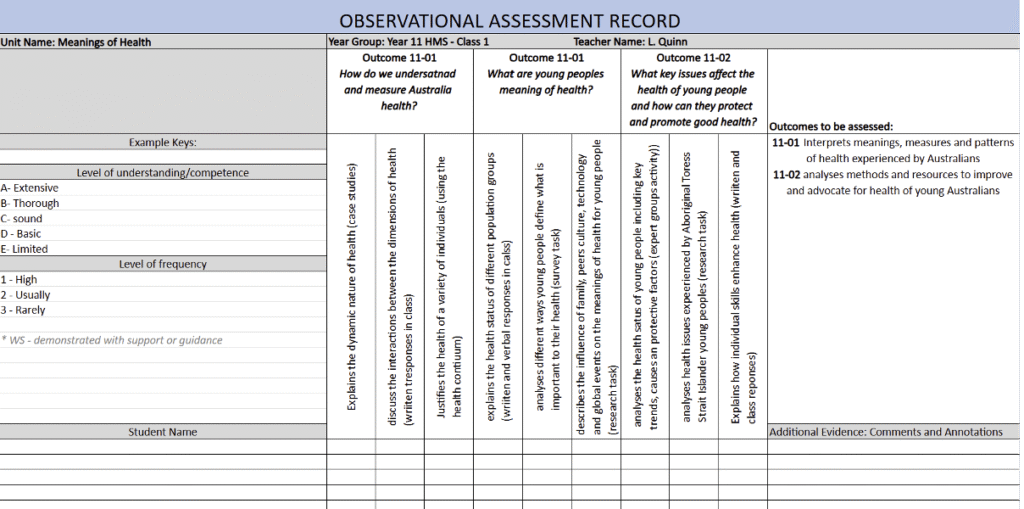
However, the trick is to collate teacher observations in an efficient manner. A simple strategy? Create a formative tracking guide for your units (see below for an example). This allows you to:
- Monitor students’ progress against key learning outcomes
- Identify misconceptions early
- Inform your teaching decisions moving forward
- Build a bank of evidence for semester reporting