NSW Child Studies 7–10 Syllabus (2025): What’s Changed and How Teachers Can Prepare
NESA has officially released the new Child Studies 7–10 Syllabus (2025) — set for implementation in all NSW schools from 2028. If you teach PDHPE, CAFS, or elective subjects, this syllabus is one of several major curriculum changes rolling out across NSW.
Whether you’re just skimming the new document or already brainstorming your first unit, this update is a shift worth exploring. At ACHPER NSW, we’ve been closely involved in the journey — from consultation to curriculum shaping — and we’re here to guide you through what’s ahead.
🔍 Key Changes in the 2025 Child Studies 7–10 Syllabus
This syllabus is more than a policy update — it’s a pivot toward real-world, inclusive, and skills-focused learning. During the Have Your Say period, ACHPER NSW had the opportunity to consult directly with NESA, submit feedback, and ask questions on behalf of our community. We’re pleased to see that many of those insights have been adopted.
Here’s what’s new in the Child Studies elective syllabus:
✔️ Clearer structure and outcomes
The syllabus now features concise, logically organised outcomes that are easier to program and assess — saving teachers time while maintaining rigour.
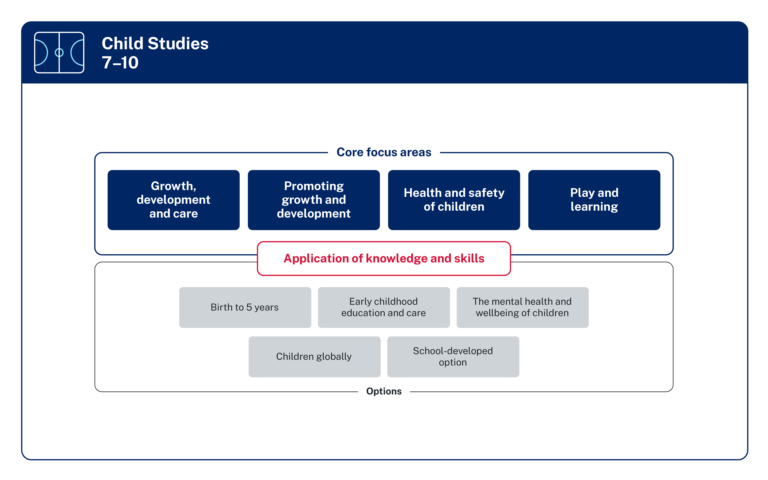
It also introduces a clearer framework for course planning, with defined expectations for both 100-hour and 200-hour course structures. For a 100-hour course, students must complete 2 core focus areas, at least one option, and one depth study. For a 200-hour course, students are required to complete all 4 core focus areas, at least two options, and two depth studies.
The core focus areas include:
- Growth, development and care
- Promoting growth and development
- Health and safety of children
- Play and learning
Optional focus areas (of which schools may choose one or more) include:
- Birth to 5 years
- Early childhood education and care
- The mental health and wellbeing of children
- Children globally
- One school-developed option (maximum of one permitted across the full course)
This structure offers both consistency and flexibility, ensuring alignment with outcomes while allowing for localised teaching choices.
✔️ Emphasis on practical, applied learning
Students will explore topics like infant care, childhood development, and global wellbeing with hands-on, scenario-based tasks.
✔️ A strengths-based approach to mental health
The mental health focus area has been refined to emphasise positive wellbeing, help-seeking behaviours, and reducing stigma — a direct result of sector feedback.
✔️ Improved Life Skills alignment
Life Skills content is more clearly connected to core content, creating a more inclusive and adaptable foundation for all learners.
✔️ Deeper cultural responsiveness
Aboriginal and Torres Strait Islander perspectives are meaningfully embedded across focus areas, supporting authentic cultural understanding — not tokenism.
✔️ New school-developed focus area
Schools now have the flexibility to create a school-developed focus area, offering space for local innovation and relevance to community context. This replaces the more loosely defined school-developed unit in the previous syllabus.
Importantly, the new syllabus sets clearer boundaries for this option:
- Schools may include only one school-developed option across a 100-hour or 200-hour course.
- The school-developed focus area must align with the syllabus outcomes and reflect the same level of academic rigour as other focus areas.
- NESA has committed to providing guidance and parameters to support schools in developing high-quality, meaningful options.
This change ensures that while flexibility remains, there’s also consistency, quality assurance, and alignment with statewide learning goals. Schools now have the flexibility to create a localised focus area — a move that encourages innovation and relevance in different community contexts.

🔎 Spotlight on Depth Studies
A key feature of the revised syllabus is the depth study — an inquiry-based learning opportunity designed to give students the chance to explore content more deeply or apply it in a meaningful way.
Depth studies are a requirement in both the 100-hour and 200-hour courses:
- 100-hour course: One depth study required
- 200-hour course: Two depth studies required
Students draw on content studied in class to consolidate, deepen, or apply their knowledge and understanding of one or more focus areas. Depth studies may be completed individually or collaboratively, depending on the needs and preferences of the cohort.
The recommended class time for each depth study is 8 to 10 hours. This provides ample opportunity for meaningful exploration without overwhelming the teaching schedule.
Depth studies can take a variety of forms, including:
- Practical inquiries
- Secondary-source investigations
- Presentations
- Research assignments
- Fieldwork reports
This approach not only supports student agency and engagement but also allows for a broader range of assessment types aligned with real-world applications.
Suggested formats include:
- Practical inquiries
- Secondary-source investigations
- Presentations, research assignments or fieldwork reports
The recommended class time is 8 to 10 hours per depth study, offering students time to explore meaningful questions or issues in depth, while teachers can assess learning in a variety of ways.
🧭 What This Means for PDHPE, CAFS, and Elective Teachers
Curriculum change is rarely small — and this one is part of a broader reform that’s reshaping PDHPE in NSW. We know you’re currently navigating:
- The rollout of Health and Movement Science
- A revised 7–10 PDHPE syllabus
- The just-released Child Studies 7–10
- Upcoming changes to PASS
- And whispers of a refreshed CAFS syllabus still to come
It’s a lot. And it’s okay to feel equal parts excited and overwhelmed.
But here’s the upside: this wave of reform isn’t random — it’s deliberately aligned. Across PDHPE, CAFS, and Child Studies, we’re seeing a shift toward:
- Streamlined content and clearer outcomes
- Stronger connections to real-world application
- Shared language and structure across syllabuses
For example, the concept of wellbeing is a central theme across these syllabuses:
- In PDHPE 7–10, students explore personal and community health, focusing on factors that influence wellbeing and strategies to enhance it.
- In Child Studies 7–10, there’s an emphasis on the mental health and wellbeing of children, encouraging students to understand and promote positive health practices for younger populations.
- In CAFS Stage 6, students examine the wellbeing of individuals and families, analyzing how various factors affect quality of life and how resources can be managed to support wellbeing.
Another example? Let’s talk about family and care.
- In PDHPE 7–10, students examine how family and community influence personal identity, relationships, and support networks — setting the scene for understanding interpersonal dynamics and social roles.
- In the new Child Studies 7–10, the Growth, development and care focus area introduces foundational knowledge about child development, physical and emotional needs, and caregiving roles.
- In CAFS Stage 6, the Parenting and Caring core explores roles, preparations, and support for parents and carers — building understanding of diverse family structures and responsibilities.
Together, these content progressions scaffold learning across stages: from early conceptual understanding in Years 7–10 to sophisticated analysis in senior years. That’s vertical alignment in action — helping students make meaningful connections across their learning journey while streamlining programming for teachers.
This alignment means that once you begin to understand the structure and intent of one syllabus, it becomes easier to engage with the others. It’s not just extra work — it’s an investment in coherence, clarity, and curriculum that makes more sense across Years 7–12.
And remember: curriculum reform isn’t just about syllabus documents — it’s about supporting the people who bring them to life. You. That’s why ACHPER NSW is committed to supporting teachers through every phase of change.
💡 ACHPER NSW Support for the Child Studies 7–10 Syllabus
We’re developing a suite of supports designed to help you confidently plan and teach Child Studies in your unique school context:
- ✔️ Planning tools, templates, and programming guides
- ✔️ Professional learning to unpack focus areas like wellbeing, family diversity, and cultural safety
- ✔️ Collaborative opportunities through workshops, webinars, and teacher networks
- ✔️ Practical classroom resources aligned to outcomes and stages
We’re not just reacting — we’re preparing, alongside you.
As always, ACHPER NSW is here to support teachers in making curriculum meaningful, inclusive, and relevant. We’re proud to have contributed to this development — and even prouder to stand beside you as we bring it to life in classrooms across NSW.